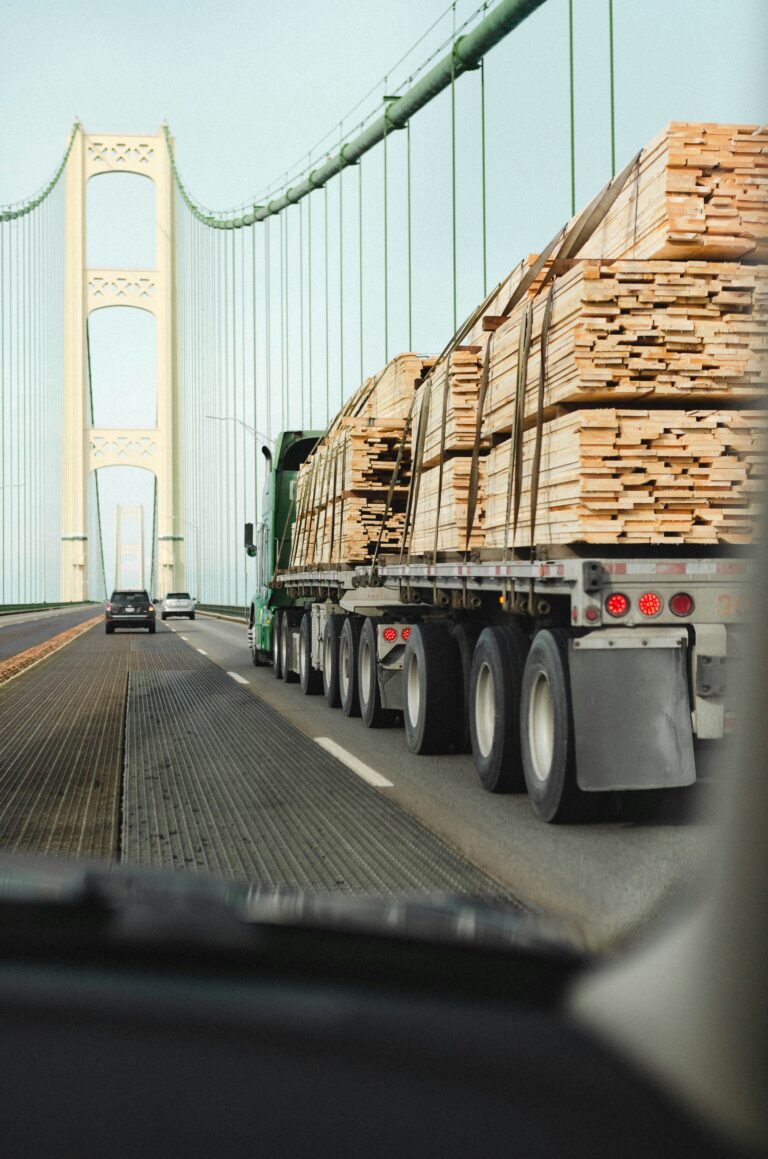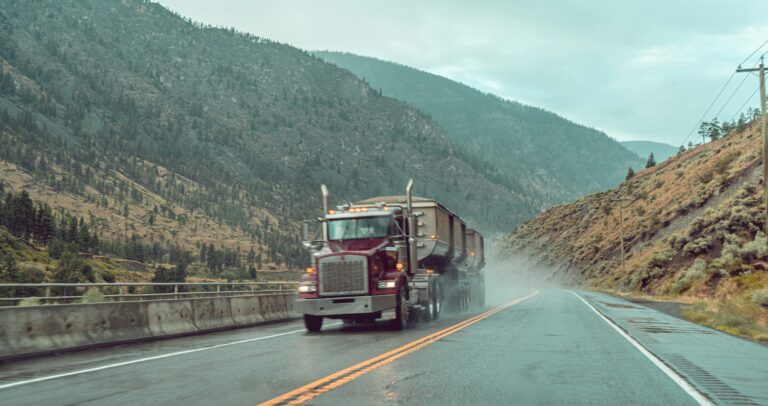
Truck driving is one of the most accessible career paths for people who want to enter the transportation industry without earning a four-year college degree. Professional drivers keep stores, factories, construction sites, warehouses, and distribution centers supplied with essential products.
According to the U.S. Bureau of Labor Statistics, approximately 237,600 openings for heavy and tractor-trailer truck drivers are projected each year, on average, from 2024 to 2034. Employment in the occupation is expected to grow by 4% during that period.
However, becoming a truck driver in the United States involves more than learning how to operate a tractor-trailer. Most professional drivers must obtain a Commercial Driver’s License, complete approved training, meet medical requirements, and pass several examinations.
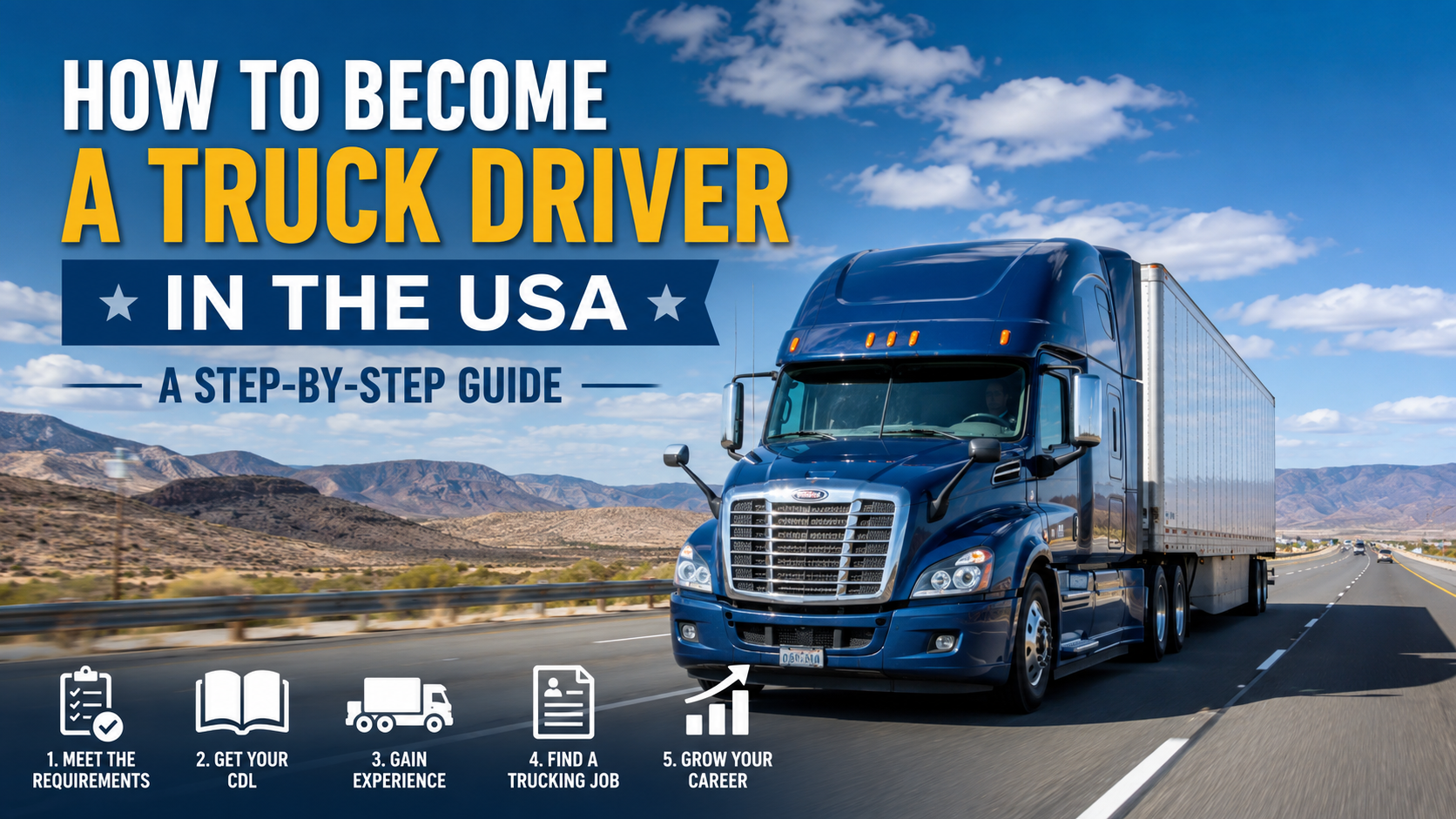
This step-by-step guide explains how to become a truck driver in the USA, from choosing the right CDL class to finding your first driving job.
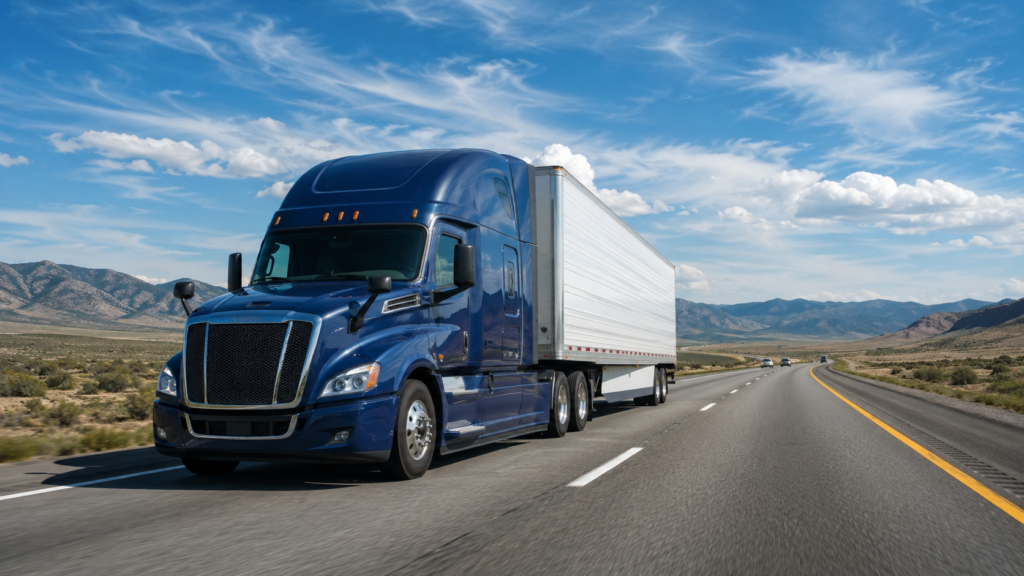
1. Understand What a Professional Truck Driver Does
A truck driver transports freight between locations using a commercial vehicle. Depending on the position, a driver may deliver goods locally, travel throughout a region, or spend several days or weeks completing long-distance routes.
Common truck-driving positions include:
- Local delivery driver;
- Regional truck driver;
- Over-the-road, or OTR, driver;
- Dedicated-route driver;
- Flatbed driver;
- Tanker driver;
- Refrigerated-trailer driver;
- Hazmat driver;
- Car-hauling driver;
- Owner-operator.
Local drivers usually return home daily, while regional and OTR drivers may spend several nights away from home. Specialized positions can offer higher compensation, but they may require additional experience, endorsements, or safety training.
Before enrolling in a truck-driving school, consider how much time you are willing to spend on the road, what type of cargo you want to transport, and whether you prefer local or interstate work.
2. Check the Basic Eligibility Requirements
Truck-driving requirements vary by state and employer. In most cases, an applicant must:
- Hold a valid non-commercial driver’s license;
- Meet the minimum age requirement;
- Provide identification and required residency or domicile documents;
- Have an acceptable driving record;
- Meet federal or state medical standards;
- Pass the applicable knowledge and skills tests;
- Be legally eligible to work in the United States.
A person generally must be at least 21 years old to operate a commercial motor vehicle in interstate commerce. Interstate commerce includes driving across state lines and certain trips connected to goods moving between states.
Drivers between 18 and 20 may be able to obtain an intrastate CDL and drive only within the state that issued the license. Specific rules differ by state, so applicants should verify the requirements with their State Driver Licensing Agency.
Applicants who are not U.S. citizens should pay particular attention to domicile, lawful-status, and documentation requirements. Non-domiciled CDL rules have changed in recent years, and eligibility may depend on the applicant’s immigration status and the issuing state. Always consult the state licensing agency and current FMCSA guidance before paying for training.
3. Choose the Correct CDL Class
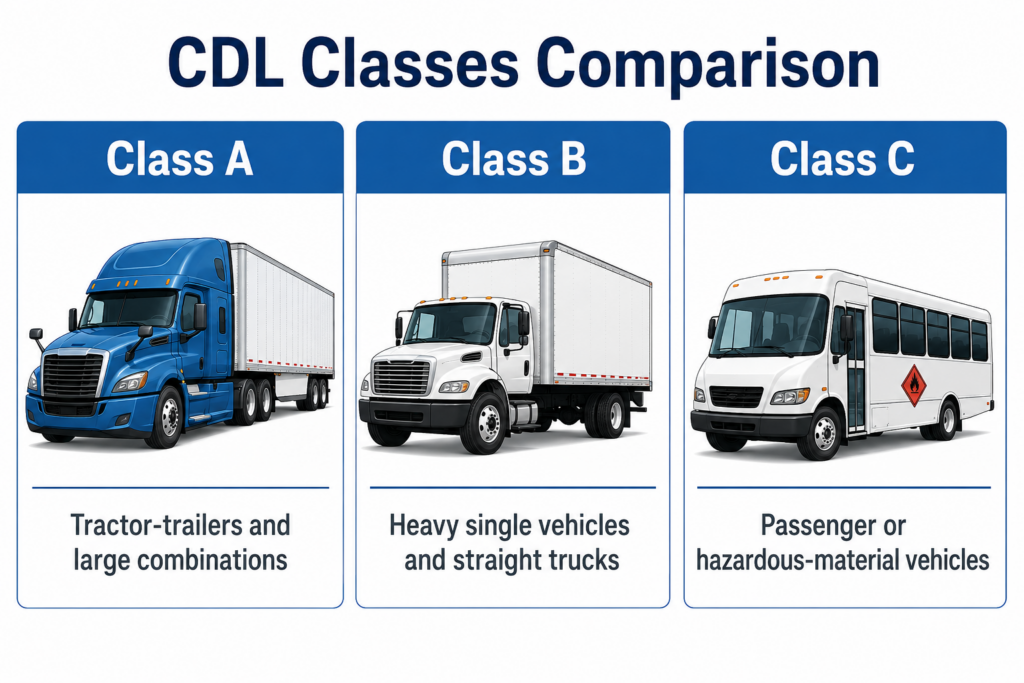
The type of Commercial Driver’s License you need depends on the vehicle you plan to operate.
Class A CDL
A Class A CDL is generally used for a combination of vehicles with a gross combination weight rating of 26,001 pounds or more when the towed vehicle has a gross vehicle weight rating of more than 10,000 pounds.
This is the most common license for tractor-trailer drivers. It can qualify a driver to operate:
- Semi-trucks;
- Tractor-trailers;
- Flatbed combinations;
- Tanker combinations;
- Livestock carriers;
- Certain truck-and-trailer combinations.
For people who want to work in long-haul trucking, a Class A CDL usually provides the widest range of employment opportunities.
Class B CDL
A Class B CDL generally covers a single vehicle with a gross vehicle weight rating of 26,001 pounds or more, or such a vehicle towing another vehicle that does not exceed 10,000 pounds.
Class B vehicles may include:
- Straight trucks;
- Large delivery trucks;
- Dump trucks;
- Box trucks;
- Concrete mixers;
- Some buses.
Class C CDL
A Class C CDL applies to certain vehicles that do not meet the Class A or Class B definitions but are designed to carry a specified number of passengers or transport regulated hazardous materials.
FMCSA establishes national CDL standards, but licenses are issued by individual states. Applicants should review their state’s CDL manual before selecting a license class.
4. Obtain a DOT Medical Examination
Many commercial drivers must demonstrate that they are physically qualified to operate a commercial vehicle safely.
A Department of Transportation physical examination must be completed by a medical examiner listed on FMCSA’s National Registry of Certified Medical Examiners.
During the examination, the medical examiner may evaluate:
- Vision;
- Hearing;
- Blood pressure;
- Cardiovascular health;
- Neurological health;
- Respiratory function;
- Musculoskeletal function;
- Medications and medical history;
- Conditions that could interfere with safe driving.
Drivers who meet the applicable requirements receive a Medical Examiner’s Certificate, also known as a DOT medical card. Interstate drivers should use FMCSA’s official National Registry to locate a certified medical examiner.
Some medical conditions do not automatically prevent a person from becoming a driver. However, additional documentation, monitoring, treatment, or a federal exemption may be required.
5. Study Your State’s CDL Manual
Every state publishes a CDL manual explaining its commercial licensing procedures, testing standards, vehicle classes, endorsements, restrictions, and safety rules.
The manual usually covers topics such as:
- Vehicle inspections;
- Basic vehicle control;
- Safe driving techniques;
- Shifting gears;
- Managing space and speed;
- Driving in difficult weather;
- Railroad crossings;
- Transporting cargo;
- Air-brake systems;
- Combination vehicles;
- Hazardous materials;
- Emergency procedures.
FMCSA recommends obtaining the CDL manual from the state where you live because each state has its own application process.
Study the manual carefully rather than relying entirely on unofficial practice-test websites. Practice tests can be useful, but the state manual should remain your primary study resource.
6. Apply for a Commercial Learner’s Permit
Before practicing in a commercial vehicle on public roads, most applicants must obtain a Commercial Learner’s Permit, commonly called a CLP.
The application process usually involves:
- Visiting the appropriate state licensing office;
- Providing identification and required documents;
- Completing the CDL application;
- Passing a vision screening;
- Paying the application and testing fees;
- Passing the required knowledge examinations.
The exact documents and fees depend on the state.
A CLP allows the holder to practice operating the applicable commercial vehicle only under legally required supervision. The supervising driver must hold the appropriate CDL and endorsements.
Federal rules have traditionally required CLP holders to wait at least 14 days before taking the CDL skills test, although applicants should verify the current rule and any additional waiting period imposed by their state.
7. Complete Entry-Level Driver Training
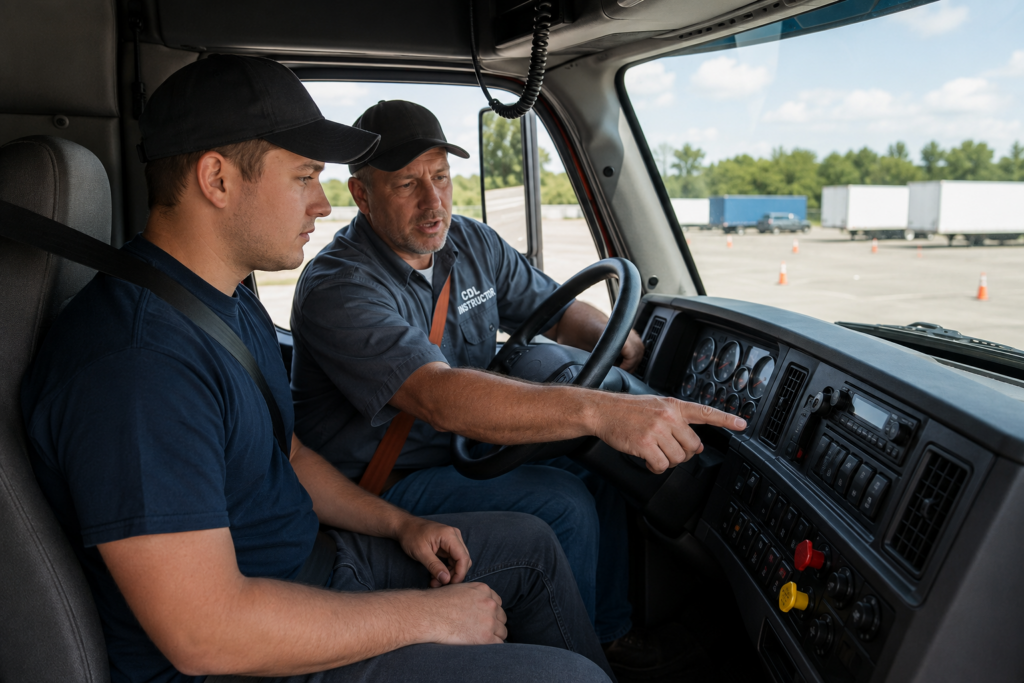
Most first-time Class A and Class B applicants must complete Entry-Level Driver Training before taking the CDL skills test.
ELDT requirements generally apply to drivers who are:
- Obtaining a Class A CDL for the first time;
- Obtaining a Class B CDL for the first time;
- Upgrading a Class B CDL to a Class A CDL;
- Obtaining a passenger endorsement for the first time;
- Obtaining a school-bus endorsement for the first time;
- Obtaining a hazardous-materials endorsement for the first time.
The training must be provided by an organization listed in FMCSA’s Training Provider Registry.
ELDT consists of theory instruction and behind-the-wheel training. Federal regulations establish the curriculum and proficiency requirements, while the training provider determines when a student has demonstrated the necessary skills.
There is no single federally required number of behind-the-wheel hours for every Class A or Class B student. However, individual states, schools, employers, or funding programs may impose their own minimum-hour requirements.
Prospective students should confirm that a school appears in the official Training Provider Registry before paying tuition. FMCSA stated in July 2026 that hundreds of noncompliant training providers had received notices of proposed removal, making provider verification particularly important.
When comparing CDL schools, ask about:
- Total tuition and additional fees;
- Training-provider registration;
- Instructor qualifications;
- Student-to-truck ratio;
- Manual and automatic transmission training;
- Scheduling options;
- Job-placement assistance;
- Employer-sponsored programs;
- Refund and repayment policies;
- Contract obligations.
Some trucking companies sponsor CDL training in exchange for a commitment to work for the company for a specified period. This can reduce upfront costs, but applicants should read the agreement carefully. Leaving early may require repaying part or all of the training expense.
8. Practice the Three Main Skills-Test Areas
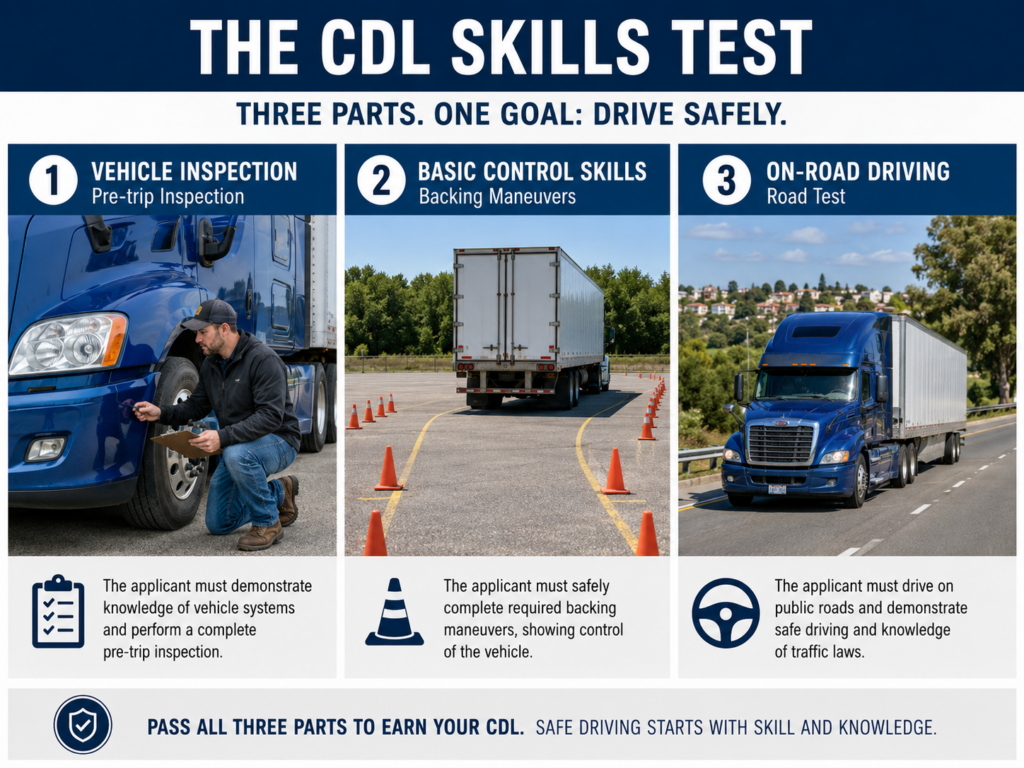
The CDL skills test typically has three major components.
Vehicle Inspection Test
The applicant must demonstrate an understanding of the vehicle’s safety components and explain how to determine whether they are in safe operating condition.
Items may include:
- Tires and wheels;
- Brakes;
- Suspension;
- Steering components;
- Lights and reflectors;
- Fluid levels;
- Coupling systems;
- Emergency equipment;
- Air-brake components.
Basic Vehicle Control Test
The applicant must complete controlled maneuvers within a designated testing area. Depending on the state and test configuration, these may include backing, offset maneuvers, parallel parking, or alley docking.
On-Road Driving Test
The examiner evaluates the applicant’s ability to operate the commercial vehicle safely in real traffic. The test may include:
- Intersections;
- Turns;
- Lane changes;
- Highway driving;
- Railroad crossings;
- Curves;
- Upgrades and downgrades;
- Traffic signs and signals;
- Proper observation and speed control.
Practice should take place in the same general type of vehicle that the applicant intends to use for the test. Testing in a vehicle without certain equipment may result in restrictions on the CDL.
For example, taking the test in a vehicle without a manual transmission may lead to a restriction preventing the driver from operating manual-transmission commercial vehicles.
9. Pass the CDL Skills Test
After completing the required training and satisfying the applicable CLP waiting period, schedule the CDL skills test through your state licensing agency or an approved third-party testing provider.
Bring all required documents, including:
- Your regular driver’s license;
- Commercial Learner’s Permit;
- Medical documentation, when required;
- Proof of completed ELDT;
- Test appointment confirmation;
- Vehicle registration and insurance documents;
- An appropriate commercial vehicle for the test.
The testing vehicle must match the class and endorsements you want to receive. It should also be legally registered, insured, and safe to operate.
Failing one section does not mean the career is over. States have their own retesting procedures, fees, and waiting periods. Review the examiner’s feedback, practice the weak areas, and schedule another attempt.
10. Choose the Necessary CDL Endorsements
Endorsements allow CDL holders to operate specialized vehicles or transport particular types of cargo.
Common endorsements include:
- H — Hazardous materials;
- N — Tank vehicles;
- P — Passenger vehicles;
- S — School buses;
- T — Double and triple trailers;
- X — Combination of hazardous-materials and tank endorsements.
Some endorsements require only a knowledge examination. Others require additional skills tests, ELDT, background checks, or security screening.
For example, first-time applicants for a hazardous-materials endorsement must complete the applicable ELDT theory training before taking the endorsement knowledge test. The hazmat endorsement also involves a Transportation Security Administration security-threat assessment.
Applicants should pursue endorsements that match their career goals. A tanker or hazmat endorsement can expand employment options, but drivers should not add endorsements without understanding the additional responsibilities involved.
11. Receive Your CDL and Review Its Restrictions
After passing the required examinations, the state licensing agency issues the Commercial Driver’s License.
Check the license carefully to make sure that:
- Your personal information is correct;
- The CDL class is correct;
- All earned endorsements are listed;
- Unexpected restrictions have not been added;
- The expiration date is correct.
A restriction can limit the type of commercial vehicle you may operate. Common restrictions may involve air brakes, manual transmissions, tractor-trailers, corrective lenses, or intrastate-only driving.
It is illegal to hold driver’s licenses from more than one state. Most drivers must obtain their CDL through their home state.
12. Prepare for Employer Screening
Receiving a CDL does not automatically guarantee employment. Trucking companies normally conduct additional screening before allowing a driver to operate company equipment.
The hiring process may include:
- Driving-record review;
- Employment-history verification;
- Criminal-background check;
- DOT drug test;
- DOT physical verification;
- Road test;
- Clearinghouse query;
- Orientation and safety training.
The FMCSA Drug and Alcohol Clearinghouse is a secure database containing information about CDL and CLP holders’ federal drug and alcohol program violations.
A driver must register with the Clearinghouse to provide electronic consent when a prospective employer conducts a full pre-employment query.
Be honest when completing applications. Inaccurate employment dates, undisclosed violations, or false statements can cause a company to reject an applicant even when the underlying issue would not have resulted in automatic disqualification.
13. Find Your First Truck-Driving Job
New drivers can apply directly to motor carriers, use transportation job boards, attend CDL-school recruiting events, or participate in employer-sponsored training programs.
When comparing entry-level positions, evaluate more than the advertised pay rate. Consider:
- Pay per mile, hourly pay, or salary;
- Guaranteed minimum pay;
- Average weekly mileage;
- Home-time policy;
- Loading and unloading responsibilities;
- Detention and layover pay;
- Health insurance;
- Retirement plans;
- Paid time off;
- Equipment quality;
- Safety record;
- Driver-facing camera policy;
- Training pay;
- Length of the employment commitment.
Ask whether the advertised compensation represents average pay, starting pay, or the earnings of the company’s highest-performing drivers.
New CDL holders often begin with dry van, refrigerated, dedicated, regional, or local delivery work. More specialized positions may require six months to several years of verifiable experience.
14. Complete Company Orientation and Driver Training
Many carriers require newly hired drivers to complete orientation and supervised driving before receiving their own assigned truck.
Orientation may cover:
- Company safety policies;
- Hours-of-service rules;
- Electronic logging devices;
- Cargo securement;
- Trip planning;
- Fuel procedures;
- Accident reporting;
- Customer requirements;
- Vehicle inspections;
- Company communication systems.
A new driver may spend several days or weeks driving with a trainer. Use this period to improve backing, trip planning, inspection routines, and communication skills.
Do not allow a trainer, dispatcher, or manager to pressure you into operating an unsafe vehicle or violating hours-of-service regulations. Professional drivers are responsible for making safe decisions even when delivery schedules are tight.
15. Build Experience and Protect Your Driving Record
A CDL is the beginning of the career, not the end of the learning process.
To build a strong professional record:
- Perform thorough pre-trip and post-trip inspections;
- Follow speed limits and company policies;
- Maintain a safe following distance;
- Avoid distracted driving;
- Keep accurate electronic logs;
- Report defects promptly;
- Protect cargo from damage;
- Communicate delays professionally;
- Maintain medical certification;
- Renew the CDL and endorsements on time;
- Avoid preventable accidents and moving violations.
A clean record and reliable work history can lead to better routes, higher-paying specialized work, private-fleet positions, or owner-operator opportunities.
How Long Does It Take to Become a Truck Driver?
The timeline depends on the state, school, test availability, and the type of CDL.
A typical process may take approximately four to twelve weeks and include:
- Studying for the CLP knowledge test;
- Completing the medical examination;
- Receiving the learner’s permit;
- Completing ELDT;
- Practicing vehicle-control skills;
- Scheduling and passing the CDL skills test;
- Completing employer orientation.
Part-time programs may take longer. Accelerated programs may be shorter, but students should make sure they receive enough behind-the-wheel practice to operate safely and pass the test.
How Much Does CDL Training Cost?
CDL-school tuition varies substantially by location, program length, license class, and available financial assistance.
Possible expenses include:
- Permit application;
- Knowledge tests;
- DOT medical examination;
- CDL-school tuition;
- Skills testing;
- License issuance;
- Endorsement testing;
- Background checks;
- Transportation and lodging;
- Retesting fees.
Community colleges and workforce-development programs may offer lower-cost training. Grants, veteran benefits, employer sponsorships, and state workforce programs may also help qualified applicants.
Before enrolling, request a written breakdown of all charges and ask whether the quoted price includes permit testing, road testing, vehicle rental, and license fees.
Can Immigrants Become Truck Drivers in the USA?
Lawfully eligible immigrants may be able to become truck drivers, but obtaining work authorization and obtaining a CDL are separate matters.
An applicant may need to provide:
- Proof of identity;
- Proof of lawful status;
- Social Security information;
- Proof of state domicile or residency;
- A valid non-commercial license;
- Work-authorization documents.
The exact requirements depend on the applicant’s immigration category, state rules, and current federal regulations. Because non-domiciled CDL regulations have recently changed, foreign applicants should verify eligibility directly with the relevant state licensing agency and FMCSA before enrolling in a school.
A training company’s promise that it can “guarantee” a CDL should never replace confirmation from the government agency that will issue the license.
Frequently Asked Questions
Do I need a college degree to become a truck driver?
No. A four-year college degree is generally not required. Drivers normally need a regular driver’s license, CDL training, a Commercial Driver’s License, and the ability to meet medical and employer requirements.
Can I become a truck driver with no experience?
Yes. Many carriers hire recent CDL-school graduates. New drivers may need to complete company orientation and drive with a trainer before operating independently.
Is CDL training mandatory?
ELDT is generally required for applicants obtaining a Class A or Class B CDL for the first time, upgrading from Class B to Class A, or obtaining certain endorsements for the first time. The training provider must be listed in FMCSA’s Training Provider Registry.
Can I get a CDL without attending a private truck-driving school?
Potentially. Training may be available through a community college, employer-sponsored program, public workforce program, or another registered provider. The important requirement is that mandatory ELDT be completed through a provider listed in the Training Provider Registry.
Do truck drivers have to pass a drug test?
Drivers applying for safety-sensitive CDL positions are generally subject to federally regulated drug and alcohol testing. Employers also conduct pre-employment Clearinghouse queries.
Can I drive across state lines before age 21?
A person generally must be at least 21 to drive a commercial motor vehicle in interstate commerce. Limited apprenticeship or exception programs may apply in specific circumstances, but they should not be treated as the standard licensing path.
Which CDL is best for a trucking career?
A Class A CDL usually offers the broadest range of truck-driving opportunities because it covers tractor-trailers and other large vehicle combinations. A Class B CDL may be sufficient for dump trucks, straight trucks, concrete mixers, and certain local-delivery positions.
Final Thoughts
Becoming a truck driver in the USA requires planning, training, and a commitment to safety. The basic path is to determine your eligibility, choose the correct CDL class, obtain a DOT medical examination, pass the learner’s-permit tests, complete ELDT, pass the CDL skills test, and apply to reputable carriers.
Requirements and fees vary between states, so your state’s CDL manual and licensing agency should be your primary sources for application instructions.
Avoid choosing a school or employer based only on promises of fast licensing or unusually high income. Verify that the training provider is officially registered, read every contract carefully, and compare jobs based on total compensation, home time, safety practices, and long-term career opportunities.
With proper training and a responsible driving record, a CDL can open the door to local, regional, long-haul, and specialized transportation careers throughout the United States.