An empty trailer may seem easier to drive than a fully loaded one. The truck accelerates more quickly, climbs hills with less effort, and uses less fuel. But when strong crosswinds begin, that lack of weight can become a serious disadvantage.
For truck drivers, especially those pulling 53-foot dry vans and refrigerated trailers, an empty or lightly loaded trailer can be one of the most vulnerable vehicles on the highway during a windstorm. The trailer still presents a huge vertical surface to the wind, but there may be very little cargo weight helping keep it firmly planted on the pavement.
A powerful gust can push the trailer sideways, move the truck unexpectedly within its lane, or in extreme cases begin lifting the trailer until the entire tractor-trailer rolls onto its side.
This is not just a theoretical danger.
The Wyoming Department of Transportation specifically identifies enclosed trailers such as 53-foot dry vans and reefers as among the vehicles most susceptible to blow-over crashes. Wyoming uses weight-based wind restrictions because the risk changes dramatically depending on trailer shape, vehicle weight, wind speed, wind direction, road geometry, and other conditions.
Understanding why this happens — and knowing when it is safer to stop — is an important skill for any professional truck driver who operates in windy parts of the United States.
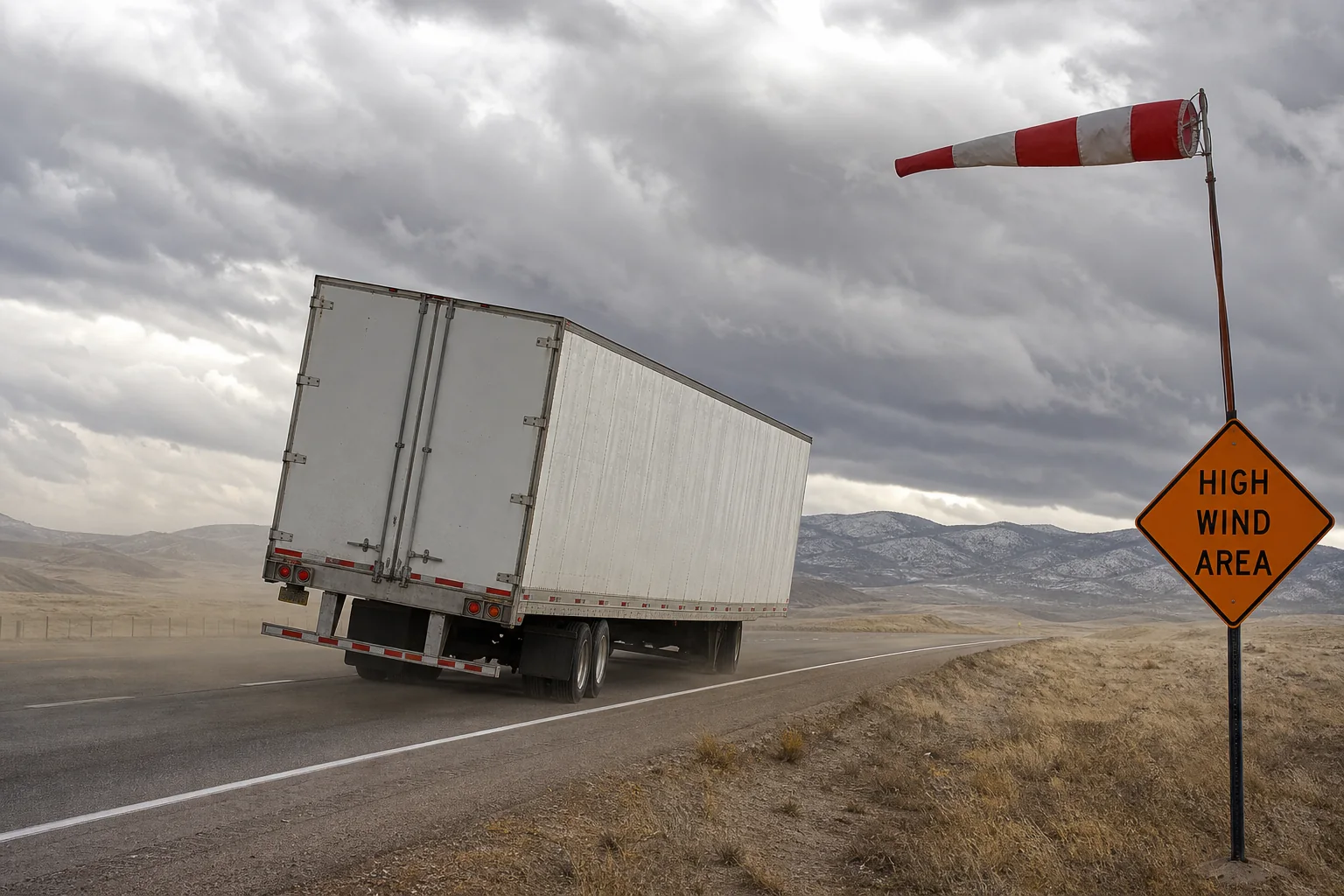
Why Is an Empty Trailer More Dangerous in High Winds?
The biggest issue is the relationship between surface area and weight.
A 53-foot dry van has a very large rectangular side. Whether the trailer contains 40,000 pounds of freight or nothing at all, the amount of side area exposed to the wind remains almost the same.
Think of the trailer like an enormous wall moving down the highway.
When a crosswind hits that wall, it creates sideways force.
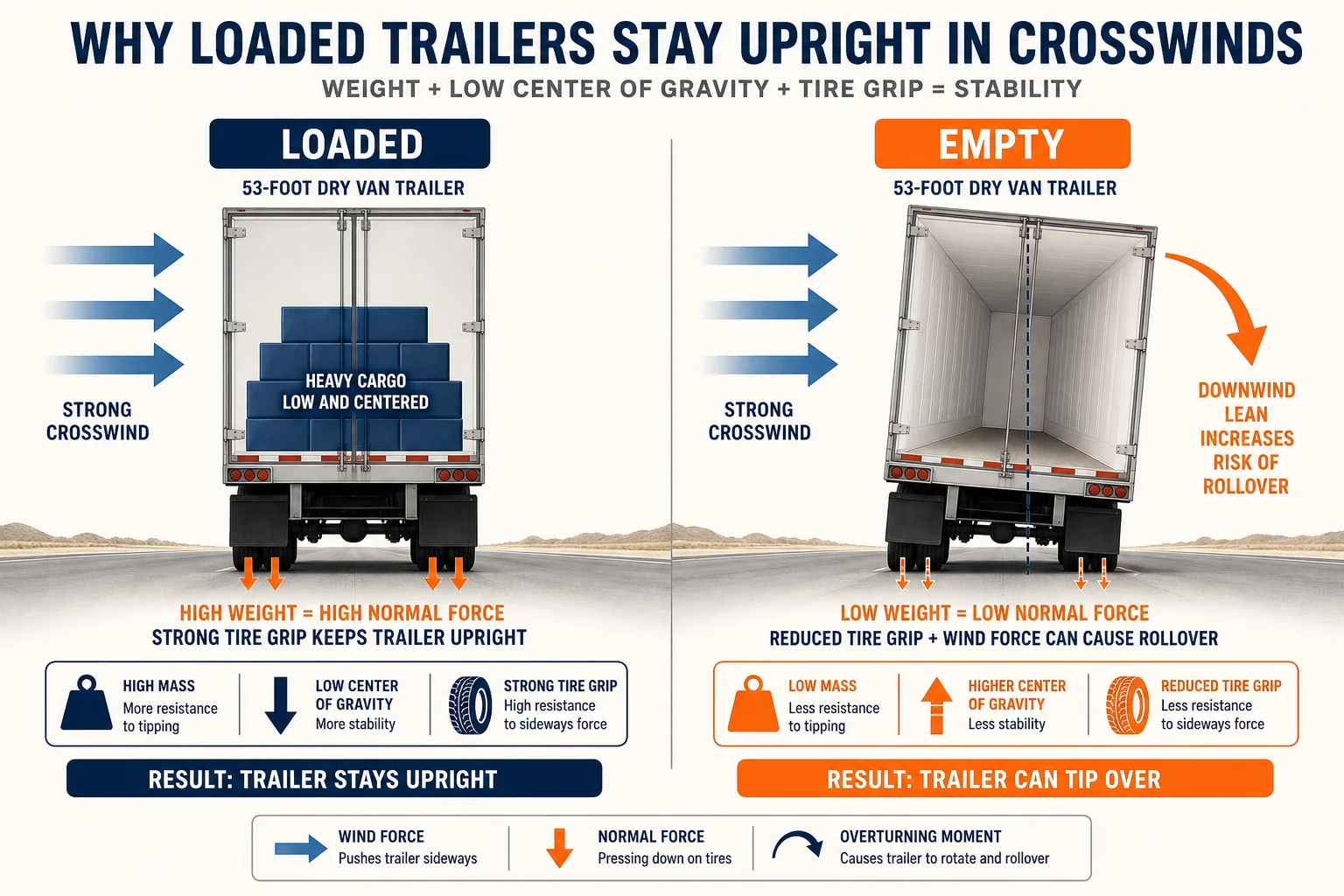
When the trailer is heavily loaded, there is much more weight resisting that force. The tires remain more firmly loaded against the pavement and considerably more force is generally required before the combination reaches a rollover condition.
When the trailer is empty, the same wind is acting against a much lighter vehicle.
That means the wind has a much greater effect relative to the vehicle's weight.
WYDOT's research into truck blow-over crashes confirms that vehicle weight is one of the major variables affecting rollover risk. Its research model considers wind speed, gust speed, wind direction, vehicle speed, vehicle weight, and roadway geometry, and Wyoming officials specifically note that lighter vehicles are more susceptible to blowing over.
This is why an empty dry van can sometimes be much more difficult to control in extreme wind than the same tractor pulling a heavy load.
The truck may feel powerful and responsive because it is light.
But from the wind's perspective, it is also easier to move.
Why Dry Vans and Reefers Are Especially Vulnerable
Not every trailer reacts to high winds in the same way.
Dry vans and refrigerated trailers are particularly vulnerable because they are high-profile enclosed trailers. Their long, tall, relatively flat sides create a large area for crosswinds to push against.
WYDOT specifically says that its experience shows enclosed trailers — including 53-foot box trailers and doubles — are among the vehicles most susceptible to blow-over events.
An empty flatbed behaves differently.
Without a large load, most of the wind can pass around and over the flat deck instead of pushing against a tall vertical wall.
An empty tanker is also shaped very differently. Its rounded body generally presents different aerodynamic characteristics than the flat side of a dry van.
This does not mean flatbeds and tankers cannot be affected by high winds. They absolutely can, especially when carrying large or unusual loads. But WYDOT notes that empty tankers and unloaded flatbeds without high-profile cargo are generally less susceptible and typically are not the primary vehicles targeted by its weight-based wind restrictions.
A dry van does not lose its "sail" when it becomes empty.
It loses weight.
That is exactly what makes the combination dangerous.
How Can Wind Actually Roll Over a Semi-Trailer?
A truck does not need to be physically picked up and thrown into the air for a blow-over to occur.
The process begins when wind creates enough sideways force against the trailer to produce a rolling moment around the tires.
Imagine looking at the trailer from the rear.
Its center of gravity is above the pavement, while the tires provide the base supporting it. A crosswind pushes against the side of the trailer above that base.
As the wind becomes stronger, the sideways force creates increasing leverage.
If that force becomes strong enough relative to the weight and stability of the vehicle, the load on the tires on the windward side can decrease. The trailer may begin leaning toward the downwind side.
At some point, the forces can exceed the combination's ability to remain upright.
Once the trailer starts tipping significantly, gravity begins working against the truck rather than helping keep it upright.
The rollover can then happen extremely quickly.
This also explains why simply saying that a truck weighs a certain number of pounds does not completely describe its risk.
Vehicle height, trailer design, road slope, wind direction, wind gusts, travel speed, center of gravity, and other factors can all influence stability.
University of Wyoming research used by WYDOT incorporates several of these variables rather than relying on wind speed alone.
Wind Force Increases Very Quickly as Wind Speed Rises
One reason wind conditions can become dangerous so quickly is that aerodynamic force does not increase in a simple one-to-one relationship with wind speed.
Wind force is related roughly to the square of wind velocity.
In practical terms, that means a relatively modest increase in wind speed can create a much larger increase in aerodynamic force against the trailer.
A 60 mph gust does not simply create 50 percent more aerodynamic force than a 40 mph gust.
The increase is much larger.
That is why a road can feel manageable for several miles and then suddenly become extremely difficult when stronger gusts arrive.
Truck drivers also need to distinguish between sustained wind and gusts.
An area may be reporting a steady wind speed that does not sound especially alarming while experiencing much stronger individual gusts. Those short, violent gusts may be what pushes a light trailer beyond its stability limit.
Wyoming experiences this problem regularly. Its 2024 crash report noted winter periods with winds commonly reaching 30–40 mph and gusts of 50–60 mph, while occasional gusts exceed hurricane-force levels of 74 mph.
Wind Direction Matters Just as Much as Wind Speed
A headwind mainly increases aerodynamic drag.
A tailwind can reduce some of the relative airflow against the front of the truck.
A strong crosswind is different because it applies force across the large side area of the trailer.
However, the most dangerous condition is not always a perfectly direct 90-degree crosswind.
Research presented by WYDOT found that the relationship is more complicated. University of Wyoming research showed that wind direction, roadway slope, vehicle weight, and travel speed can interact, and in some situations a slightly angled headwind can produce particularly high blow-over risk.
This is one reason drivers should not rely on a simple rule such as:
"The wind is coming from the front, so I'm safe."
Wind can also change direction rapidly because of hills, buildings, bridges, cuts through terrain, and passing weather systems.
The wind direction you feel at one point on the highway may not be the direction you experience one mile later.
Why Wind Gusts Can Surprise Truck Drivers
The most dangerous wind event is often not a steady wind that the driver has been correcting for during the previous 20 miles.
It is the sudden gust that arrives when the driver is not expecting it.
Imagine driving through an area where the truck has been protected from the wind by a hill, row of buildings, tree line, bridge structure, or another large vehicle.
The steering feels relatively normal.
Then the truck exits that protected area and becomes exposed to the full crosswind.
The trailer can suddenly move sideways.
The opposite can happen when passing a large structure or another tractor-trailer. The vehicle may temporarily block some of the wind. The driver instinctively adjusts steering pressure because the truck suddenly stops being pushed sideways.
A moment later, the truck leaves that wind shadow and the crosswind hits the trailer again.
That rapid change can produce a surprisingly large movement.
This is especially dangerous on icy roads because the tires have less ability to resist lateral forces.
WYDOT specifically warns that controlling light, high-profile vehicles in high winds becomes even more difficult in winter when road surfaces are slick.
Why Open Highways Can Be So Dangerous
Some of the most dangerous wind conditions occur on roads that appear easy to drive.
There may be no mountains, sharp curves, heavy traffic, or snow.
Instead, the highway passes through miles of open terrain.
That means there is very little to block the wind.
Wyoming's Interstate 80 and Interstate 25 are classic examples. Large open areas allow strong winds to develop across the roadway, and certain locations are particularly well known for blow-over incidents.
WYDOT reports that the majority of Wyoming's wind-related blow-over crashes occur on I-80 and I-25. In 2024 alone, the state recorded 83 blow-over crashes. Heavy trucks over 26,000 pounds represented approximately 41 percent of the vehicles involved.
The risk is not limited to winter.
WYDOT warns that powerful winds capable of affecting light and high-profile vehicles can occur even during summer.
That is why a clear blue sky does not automatically mean good trucking weather.
Wind can be dangerous even when there is no rain or snow anywhere in sight.
Real Blow-Over Crashes Show How Serious the Problem Is
Wyoming provides some of the clearest real-world examples because the state closely tracks wind-related crashes.
During a major wind event in December 2025, WYDOT reported 39 blow-over crashes in only three days. Many of the vehicles were below the recommended weight thresholds, and officials noted that some trailers were completely empty.
Conditions became even more extreme during another windstorm in March 2026.
WYDOT and the Wyoming Highway Patrol reported as many as 32 blow-over crashes across the state in a single day. At least 15 occurred on Interstate 25 and as many as 12 occurred on Interstate 80 between Laramie and Arlington.
Wind gusts during the event reached 109 mph.
These crashes are dangerous not only for the truck driver involved.
A blown-over tractor-trailer can block multiple lanes, strike nearby vehicles, scatter cargo and debris across the highway, damage barriers and pavement, and force authorities to close the road.
One driver's decision to continue during an extreme wind event can therefore affect hundreds or thousands of other motorists.
Is There a Specific Wind Speed That Is Too Dangerous for an Empty Trailer?
There is no universal wind-speed number that guarantees whether a particular tractor-trailer will or will not roll over.
This is extremely important.
You may hear drivers say things such as:
"40 mph is fine."
"Anything under 50 mph is safe."
"My truck can handle 60 mph gusts."
Those rules are unreliable.
Actual risk depends on multiple variables:
- Trailer type
- Vehicle weight
- Cargo weight and position
- Wind direction
- Gust speed
- Road direction
- Vehicle speed
- Road slope
- Surface conditions
- Trailer height and shape
- Local terrain
WYDOT's modern weight-based closure system exists precisely because a single wind-speed threshold does not accurately describe every vehicle's risk. The state adjusts minimum vehicle-weight restrictions according to current and forecast wind conditions.
A heavily loaded truck may remain permitted while an empty dry van is prohibited from traveling on the same highway.
Even when your vehicle is technically above the posted minimum weight, WYDOT warns that unpredictable gusts can still create a blow-over risk and recommends drivers stop if they are having difficulty controlling the vehicle.
The safest approach is therefore not memorizing a universal wind number.
It is understanding your truck and following official restrictions and current conditions.
How Vehicle Speed Affects Wind Risk
Vehicle speed can also influence blow-over risk.
The important factor is the relative airflow acting on the vehicle.
The truck is already moving through the air at highway speed. When natural wind is added from another direction, the trailer experiences a combined airflow that may be stronger or come from a different effective angle than the reported wind alone would suggest.
This is one reason vehicle speed appears as a factor in Wyoming's blow-over risk models.
Reducing speed may improve control in some windy conditions, but drivers should not interpret this to mean that any windstorm becomes safe if they simply drive slowly enough.
If authorities have closed the road to your vehicle class or weight, slowing down does not cancel the restriction.
And if the trailer is already being pushed violently between lanes, waiting for it to get worse before stopping is a poor strategy.
The safest speed during extreme winds may eventually become zero mph in a safe parking area.
Why Bridges and Exposed Areas Can Be Worse
Drivers should pay particular attention when approaching exposed sections of highway.
Bridges can be especially challenging because there may be fewer nearby terrain features to block the wind.
The transition onto an exposed bridge can also create a sudden change in crosswind intensity.
Similar effects can occur when a highway leaves a canyon, passes between hills, crosses open farmland, or reaches a high plateau.
Wind may also be channeled by terrain.
Two hills can act like a funnel, accelerating airflow through the space between them.
A driver who has experienced moderate winds for the previous hour may therefore encounter a dramatically stronger gust in one small section of road.
This is another reason official road information is useful.
Local transportation departments often know which highway sections repeatedly experience dangerous wind events even when a driver unfamiliar with the area does not.
Why Passing Other Trucks Can Become More Difficult
Passing in heavy crosswinds deserves additional caution.
A large tractor-trailer creates its own wind disturbance and can temporarily block the natural crosswind.
Suppose the wind is pushing strongly from the passenger side.
As you begin passing another truck, that truck may partially shield your trailer from the wind. The steering input you were using to compensate for the crosswind suddenly becomes too much.
Then, as you clear the other truck, the full crosswind hits again.
The trailer can move unexpectedly in the opposite direction.
The same effect can occur when another large truck passes you.
This is why strong winds require additional space and smooth steering.
Rapid steering corrections can make an already unstable situation worse.
An Empty Reefer Can Still Be Dangerous
Some drivers assume a refrigerated trailer is automatically much safer than an empty dry van because the reefer is heavier.
A reefer normally does weigh more because it includes insulation, refrigeration equipment, additional structural components, and fuel for the refrigeration unit.
That additional weight can provide more stability than an otherwise similar empty dry van.
But a reefer still has the basic shape that makes enclosed trailers vulnerable.
It is tall.
It is long.
And it presents a large vertical surface to crosswinds.
WYDOT specifically includes refrigerated freight trailers among the enclosed trailers susceptible to blow-over conditions.
So an empty reefer should not be treated as immune simply because it weighs somewhat more than an empty dry van.
Does Adding Weight Make an Empty Trailer Safer?
In basic physics, additional properly positioned weight generally increases resistance to a wind-induced rollover.
But drivers should not improvise by adding random ballast to a trailer simply because strong winds are expected.
Cargo must be transported legally and properly secured. Adding weight can affect axle limits, gross vehicle weight, cargo securement, vehicle handling, and company procedures.
The correct response to dangerous wind conditions is not trying to invent a heavier load.
It is to follow dispatch and carrier procedures, monitor official road restrictions, and wait when necessary.
If the highway authority says your vehicle weight is below the allowed minimum for current conditions, you do not solve the problem by finding something heavy to put in the trailer.
You stop until conditions permit safe and legal travel.
Wyoming's Weight-Based Wind Restrictions
Wyoming provides one of the most developed systems in the country for dealing with truck blow-over risk.
WYDOT has restricted light, high-profile vehicles during dangerous wind events since 2011. In 2023, the department introduced its weight-based wind closure system after research from the University of Wyoming helped quantify the relationship between wind conditions, vehicle weight, road geometry, and rollover risk.
During dangerous conditions, electronic highway signs can display a minimum vehicle weight.
Vehicles at or below the displayed weight may be prohibited from continuing.
The system is particularly aimed at vehicles such as:
- Dry vans
- Reefers
- Moving trucks
- Box trucks
- Enclosed trailers
- Campers and RVs
- Light or empty commercial vehicles
The minimum weight can change as the wind changes.
This is important because a driver may have been legal to travel earlier in the day but become restricted later when gust speeds increase.
WYDOT advises drivers to check current road and wind information frequently during high-wind events.
What Does "Blow-Over Risk" Mean?
A blow-over warning is exactly what it sounds like: conditions are capable of producing enough wind force to overturn susceptible vehicles.
Drivers should not interpret the warning as:
"Be careful."
It can mean:
Your vehicle may not remain upright under the expected conditions.
WYDOT advises drivers of light and high-profile vehicles not to travel when a blow-over risk advisory applies to them. Wyoming's brochure warns that disregarding applicable closures can result in enforcement consequences, and drivers involved in crashes may also face costs associated with cleanup or property damage.
More importantly, no delivery is worth risking a rollover.
Wind warnings exist because authorities have already seen the consequences of drivers attempting to continue.
Warning Signs That the Wind Is Becoming Too Strong
A professional driver should notice changes in how the truck behaves before reaching the point of complete loss of control.
One warning sign is needing increasingly large steering corrections just to stay centered in the lane.
Another is feeling the trailer repeatedly push or pull the tractor.
You may see the trailer moving noticeably in the mirrors or feel the combination lean when large gusts arrive.
If maintaining lane position is becoming difficult, the situation is already serious.
Do not wait until the trailer lifts wheels from the pavement before deciding the wind is excessive.
WYDOT explicitly advises drivers to pull over at a safe location such as a rest area, parking area, or town when strong winds make it difficult to maintain control, even if the vehicle is technically above a posted weight restriction.
Professional judgment should begin before the emergency.
What Should You Do Before Entering a High-Wind Area?
Check conditions before reaching the dangerous section.
For Wyoming routes, that means checking official WYDOT road information and Wyoming 511 rather than relying only on a general weather app.
Other states have their own DOT traveler-information systems.
Look at:
Current wind speeds and gusts. A normal weather forecast may show average wind but not fully communicate powerful local gusts.
Road restrictions. Check whether light, high-profile vehicles or vehicles below a certain weight are restricted.
Your actual vehicle weight. An empty tractor-trailer and one carrying 35,000 pounds of freight have very different stability characteristics.
Road direction. A strong wind running parallel to your route can become a crosswind after the highway changes direction.
Alternate stopping locations. Know where you can safely wait if conditions deteriorate.
Planning before entering the wind zone is far easier than trying to find somewhere to stop after the trailer becomes difficult to control.
Where Should You Stop During Dangerous Winds?
If the conditions become unsafe, look for a proper parking location.
Good choices may include a truck stop, rest area, company terminal, large commercial parking area, or town where legal truck parking is available.
Avoid simply parking on an exposed highway shoulder unless an emergency leaves no safer alternative.
The shoulder places the truck close to high-speed traffic and may still expose the trailer to exactly the same wind conditions that made driving dangerous.
Parking location and orientation can also matter.
A truck positioned with the trailer's broad side directly facing the strongest winds may still experience substantial wind loads even while stationary.
Choose the safest available location and follow company or local instructions when facilities are directing commercial vehicles during closures.
Do Not Let Dispatch Pressure Change the Safety Decision
Wind delays can create scheduling problems.
A load may have a strict appointment.
The receiver may close soon.
Dispatch may want to know whether you can make the delivery.
None of those factors changes the physics acting on the trailer.
If the highway is legally closed to your vehicle, you cannot continue simply because the load is important.
Even if the road remains technically open, the driver is the person physically experiencing the conditions.
A dispatcher hundreds of miles away cannot feel the steering wheel moving or see the trailer being pushed toward another lane.
Communicate the problem clearly.
Explain the wind conditions, your vehicle weight, any official restrictions, and where you intend to stop.
A late load can be rescheduled.
A rolled tractor-trailer cannot.
Why "Everyone Else Is Driving" Is a Bad Reason to Continue
One of the most dangerous forms of pressure comes from watching other trucks continue.
You may be sitting at a truck stop while other tractor-trailers keep entering the Interstate.
That does not mean your combination is safe.
Their trailers may be loaded.
Your trailer may be empty.
Their total vehicle weight may be significantly higher.
Their trailer shape may be different.
The wind restriction may apply to you but not to them.
Or they may simply be taking a risk you should not copy.
WYDOT's weight-based system demonstrates exactly why comparing trucks visually is unreliable. Two tractor-trailers that look almost identical from the outside can have dramatically different blow-over risk because one weighs tens of thousands of pounds more than the other.
Drive your truck.
Not theirs.
Common Mistakes Drivers Make in High Winds
One common mistake is assuming that an empty trailer is easier to control simply because it is easier to pull.
Another is using a single wind-speed number as a universal safety limit without considering gusts, vehicle weight, wind direction, or road geometry.
Drivers can also become overconfident after traveling through strong wind without a problem for several hours. Research discussed by WYDOT found that trucks may travel through hazardous corridors successfully until changing local wind conditions suddenly produce several blow-over crashes within a short period.
This is why the thought:
"I've been driving in this wind all morning and nothing happened"
does not prove that the next 20 miles are safe.
Another mistake is waiting too long to stop.
If the truck is already crossing lane markings during gusts, the driver should not be trying to discover exactly how much stronger the wind can become.
Finally, never ignore an official wind closure.
Those restrictions exist because transportation agencies have combined weather data, crash history, and vehicle-risk research to identify conditions where certain vehicles should not continue.
High Winds Are More Dangerous When Combined With Ice
Wind alone can push a trailer sideways.
Ice reduces the amount of traction available to resist that movement.
Combine the two and the driver may face both sliding and rollover risk.
Even if the wind is not strong enough to directly overturn the truck, a gust can push the trailer sideways on a slick road. Once the combination begins sliding, the driver's ability to correct the movement is dramatically reduced.
Blowing snow can also reduce visibility, making it harder to see lane markings and other vehicles.
WYDOT notes that more than a quarter of blow-over accidents occur when winter conditions are also present.
This is why windy winter routes deserve especially conservative decision-making.
Are Loaded Trailers Safe in Any Wind?
No.
A loaded trailer is generally more stable than the same trailer when empty, but additional weight does not make a tractor-trailer invincible.
Extremely powerful gusts can affect heavily loaded commercial vehicles too.
The risk also depends on how the weight is distributed, road geometry, trailer design, travel speed, and wind angle.
WYDOT specifically warns drivers that even trucks above the minimum weight shown on a wind restriction sign can still experience dangerous conditions because winds are unpredictable and roadside sensors cannot measure every possible local gust.
If you are struggling to maintain control, the fact that your truck is legally heavy enough to continue does not mean continuing is smart.
Are Empty Trailers Always More Dangerous?
For high-profile enclosed trailers in crosswinds, being light generally increases blow-over vulnerability.
But that does not mean every empty trailer is more dangerous in every driving situation.
An empty truck has advantages in other conditions. It accelerates more easily, requires less engine power on grades, and may have more braking capacity relative to its total weight.
The specific issue is wind stability.
A dry van or reefer combines a large wind-catching surface with relatively little weight when empty.
That particular combination is what creates the problem.
Professional drivers should therefore change the way they think about weather depending on whether the trailer is loaded or empty.
The same highway and wind forecast can represent a very different level of risk after a delivery than it did before unloading.
Frequently Asked Questions
Why Do Empty Semi-Trailers Blow Over More Easily?
An empty enclosed trailer has nearly the same large side area exposed to the wind as a loaded trailer but substantially less weight resisting the sideways and overturning forces. This makes it more vulnerable to strong crosswinds and gusts.
Are 53-Foot Dry Vans Dangerous in High Winds?
They can be. WYDOT specifically identifies enclosed box-type trailers, including 53-foot dry vans and reefers, as among the vehicles most susceptible to blow-over conditions.
What Wind Speed Will Flip an Empty Trailer?
There is no universal number. Blow-over risk depends on wind speed, gusts, direction, truck speed, weight, trailer shape, road geometry, and surface conditions. Drivers should follow official road restrictions rather than relying on a fixed wind-speed rule.
Are Reefers Safer Than Dry Vans in Wind?
An empty reefer may be somewhat heavier than an empty dry van, but it is still a high-profile enclosed trailer with a large side surface. WYDOT includes reefers among trailer types vulnerable to blow-over conditions.
Are Empty Flatbeds Dangerous in High Winds?
Wind can affect any commercial vehicle, but an empty flatbed without high-profile cargo presents much less vertical surface area than a dry van. WYDOT notes that empty flatbeds and tankers are generally less susceptible to blow-over and are typically not included in its weight-based restrictions unless their loads create a high profile.
Should I Keep Driving if the Truck Is Hard to Keep in the Lane?
If strong winds are making the vehicle difficult to control, conditions may already be unsafe. WYDOT recommends finding a safe rest area, parking area, or town and waiting for winds to subside rather than continuing simply because the road remains open.
Final Thoughts
An empty trailer can be deceptively dangerous in high winds.
The truck may feel lighter, faster, and easier to pull, but an empty 53-foot dry van or reefer still presents an enormous vertical surface to the wind. Removing the freight dramatically reduces weight without significantly reducing the area available for the wind to push against.
That is why empty and lightly loaded enclosed trailers are particularly vulnerable to sideways movement and blow-over crashes.
Real-world experience supports the concern. Wyoming recorded 83 blow-over crashes in 2024, followed by major wind events in which dozens of vehicles overturned within just a few days — and sometimes within a single day.
Drivers should never rely on one universal "safe" wind speed.
Vehicle weight, trailer design, gust strength, wind direction, vehicle speed, road geometry, ice, and local terrain can all change the risk.
Before entering a windy corridor, check official DOT conditions and restrictions. Know whether your trailer is empty or lightly loaded. Pay attention to how the combination is behaving and take warning signs seriously.
If the truck is becoming difficult to control, find a safe place to stop.
If your vehicle is prohibited by a weight-based wind closure, wait.
And never continue simply because other trucks are still moving.
A professional driver's job is not to prove that an empty trailer can survive one more gust.
It is to recognize when conditions have become unsafe before that gust arrives.